
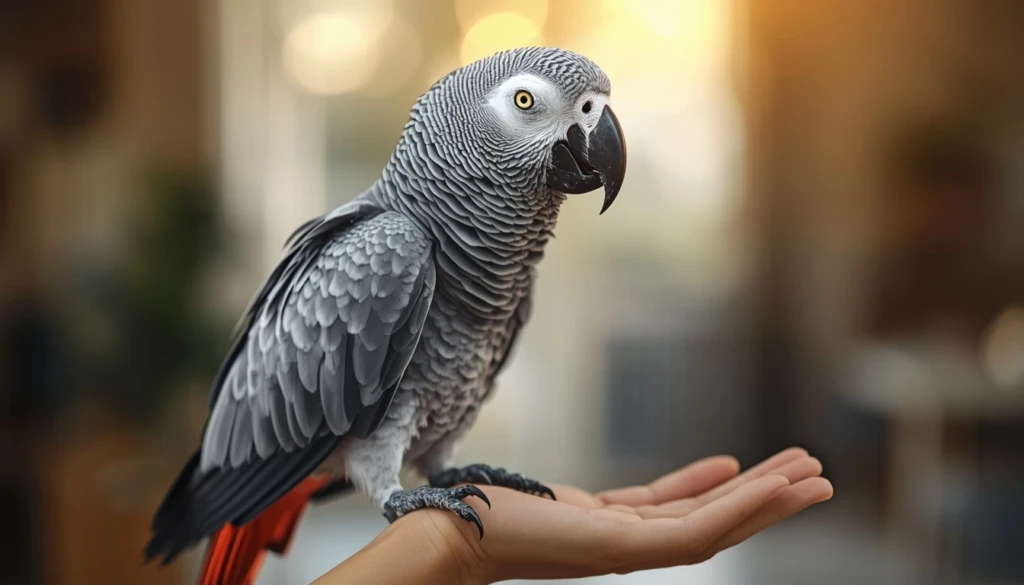
Most parrot owners want a bird that talks.
African Grey owners want something rarer: a bird that means what it says. With the right African Grey Parrot talking training, your bird won’t just mimic random sounds.
It will say “goodbye” when you grab your keys, ask for water at the bowl, and protest when you take away a favourite toy. That’s not luck.
That’s the result of consistent, science-backed training built on trust and a deep understanding of how this bird’s brain actually works.
Why African Greys Can Actually Learn to Talk
African Greys aren’t just good mimics. Their brains are wired for language in a way that separates them from nearly every other bird on the planet.
Research published in PLOS ONE confirmed that the parrot brain contains a dual-layer song system, a “song system within a song system.” The outer shell layer is unique to parrots and controls the social side of vocal learning.
This means African Greys don’t just copy sounds. They learn when and why to use them, based on what’s happening around them, much like a human child does.
Comparative neuroscience has also found that when African Greys process human speech, they activate brain regions similar to Broca’s and Wernicke’s areas, the zones responsible for speech production and understanding in humans.
Their enlarged vocal organ, called the syrinx, gives them precise physical control over sound. This is why your Grey doesn’t just say “hello“, it says it in your voice, at exactly the right moment.
Did You Know: African Greys are one of the only non-human animals that can learn to use words referentially, meaning they attach words to specific objects, actions, and needs rather than just repeating sounds.
Set Up the Right Environment Before You Say a Single Word
Training starts before the first lesson, and choosing a healthy, socialized bird from the best exotic bird provider ensures your environment is built on a foundation of quality and trust.
A quiet, calm, low-distraction space is non-negotiable for African Grey parrot speech training.
Loud TVs, competing appliances, and chaotic energy make your Grey feel unsafe, and a bird that doesn’t feel safe won’t risk vocalizing. Start with daily calm handling, step-up practice, and relaxed social time before any formal speech sessions begin.
One of the most effective (and underused) techniques is narrating your day.
Talk while you prepare food. Describe what you’re doing. Use your Grey’s name often. This creates a passive “language bath”; your bird starts building associations between words and real-world actions before you’ve taught a single thing on purpose.
Pro Tip: The best times for active training are early morning after uncovering the cage and again in the late afternoon, when African Greys are naturally at their most alert.
Step-by-Step Parrot Training: From First Sounds to Clear Words
Once trust is in place, formal training can begin.
The golden rule for step-by-step parrot training is simple: short, frequent, and contextual sessions work far better than long, exhausting ones.
Aim for 5–10 minutes, two to three times per day. Start with high-frequency words that will naturally come up in daily life, such as “hello,” “bye,” your bird’s name, “step up,” and “good bird.” These aren’t random choices.
They’re words your Grey will hear repeatedly in real situations, which gives them the context needed to understand meaning.
Speak slowly, clearly, and with warmth.
The emotional tone you use matters just as much as the pronunciation itself. African Greys respond to animated, genuine speech; flat, robotic repetition rarely gets results.
When your Grey produces even a rough attempt at the target word, reward immediately, use a favourite treat, enthusiastic praise, or access to a beloved toy.
Over time, raise the bar, reward only closer, clearer attempts rather than any vocalization. Never punish incorrect sounds.
Punishment shuts down vocalization entirely and can set your training back by months.
Always anchor each new word to a specific moment or action. Say “step up” every single time you ask your bird to step onto your hand.
Say “good morning” every time you uncover the cage. Consistent pairing is what turns a copied sound into real communication.
The Model/Rival Method: The Most Powerful Tool in Parrot Talking Tips
If there’s one technique that stands above the rest in parrot talking tips, it’s the Model/Rival method.
Dr. Irene Pepperberg pioneered this approach, originally developed by Dietmar Todt, and the research behind it is some of the most compelling in animal cognition.
Here’s how it works. Two human trainers interact in front of the bird. One acts as the teacher. The other acts as both the “model” (demonstrating the correct response) and the “rival” (competing with the bird for the teacher’s attention and reward).
The bird watches the model correctly label an object and receives praise. Then the bird tries to do the same for its own reward.
If the model gives a wrong or garbled answer, the trainer withholds the reward, showing the bird that accuracy is what earns reinforcement.
This method mirrors how wild parrots actually learn.
In flocks, vocalizations are picked up through social observation and interaction, not isolation. It also builds joint attention, the shared focus on an object between two communicators, which is one of the foundations of real language use, according to research published in the Wellbeing International Studies Repository.
- At home, adapt this with a partner or older child
- No second person? Audio or video recordings of human exchanges around objects can work too
- The key is that your bird watches a communicative exchange happening around something, not just hears an isolated word repeated
Try This: Start with a simple object like a cup.
Have one person ask, “What’s this?” while the other answers “cup” and gets rewarded. Let your Grey watch the whole exchange before you invite them to try.
Why Your African Grey Isn’t Talking Yet And How to Fix It
If your Grey isn’t vocalizing yet, don’t panic. Most African Greys begin meaningful vocalization between 6 and 12 months of age. Rescue birds or highly cautious individuals often take longer.
The most common mistakes that slow down progress include:
- Mindless repetition without context — saying a word 50 times in a row with no object, action, or emotion attached does very little
- Over-excitement during sessions — erratic energy causes Greys to shut down rather than open up
- Inconsistent cues — using “step up” and “come here” interchangeably confuses the word-action link your bird is trying to build
- Ignoring early babbling — soft, garbled sounds are the foundation of real speech; rewarding these early attempts speeds up progress significantly
Warning: If your bird has gone silent after previously vocalizing, don’t assume it’s a training issue.
Respiratory problems, a sore throat, or nutritional deficiencies can physically prevent vocalization. A vet check is the right first step.
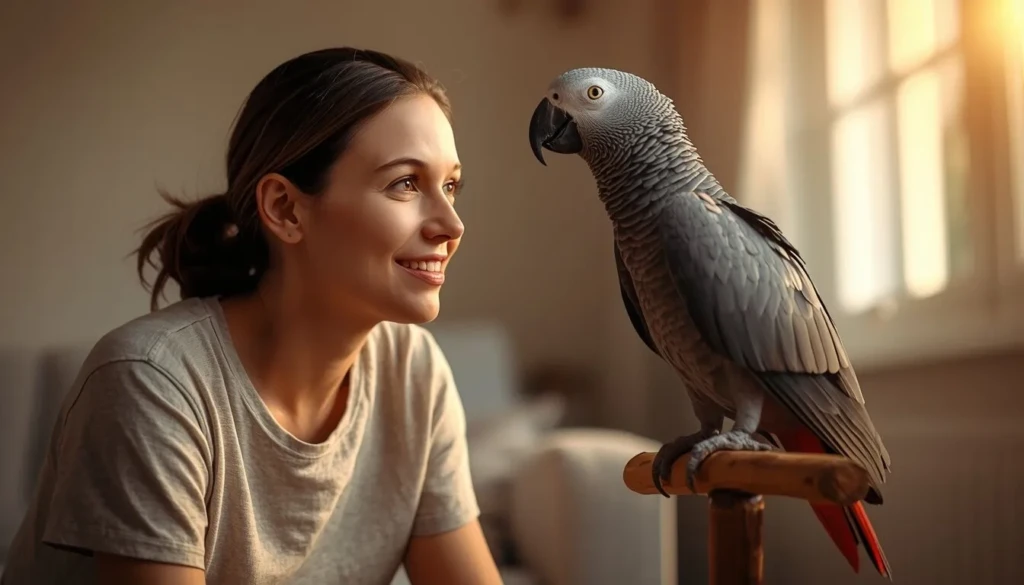
The most important mindset shift in positive reinforcement for parrots is this: stop thinking of talking as a performance your Grey delivers for you.
Start thinking of it as a conversation you’re building together. African Greys don’t talk to impress. They talk to connect, request, and communicate real needs. Train with that in mind, and fluency will come.
Your African Grey Has More to Say Than You Think
African Grey talking training isn’t about getting a bird that performs on command. It’s about building a relationship where real communication flows both ways.
When you create the right environment, anchor words to meaningful moments, use proven methods like the Model/Rival technique, and stay consistent, your Grey won’t just talk.
It will have something to say. Give it the tools, and it will surprise you every single day.
African Grey Talking Training: Common Questions Answered
How long does it take for an African Grey to start talking?
Most African Greys begin vocalizing between 6 and 12 months of age, though some individuals, especially rescues, take considerably longer.
What are the best high-value treats for training?
The best training treats are small, highly desirable foods your bird rarely gets otherwise, such as a sliver of almond, a tiny piece of walnut, or a favourite fruit bite that can be eaten in seconds.
Can older African Greys learn to talk?
Yes, older African Greys can absolutely learn to talk, though progress may be slower and require more patience and consistent contextual repetition.
Why does my African Grey whistle but not speak?
Whistling is easier to produce than speech, so if your Grey is rewarded for whistling, it has little reason to put in the extra effort that words require.
Is punishment effective if my parrot says something unwanted?
No, punishment suppresses all vocalization, not just the unwanted word, and can seriously set back your training progress.