
Macaws are not hard to feed badly. Toss in some sunflower seeds, maybe a grape, and call it a day. That is what most people do, and it is why so many captive macaws end up with fatty liver disease, feather problems, and shortened lives.
Getting the diet right is not complicated, but it does require understanding what these birds actually eat when left to their own devices, and then translating that into something realistic for your kitchen. This guide covers both.
Understanding the Macaw’s Natural Diet
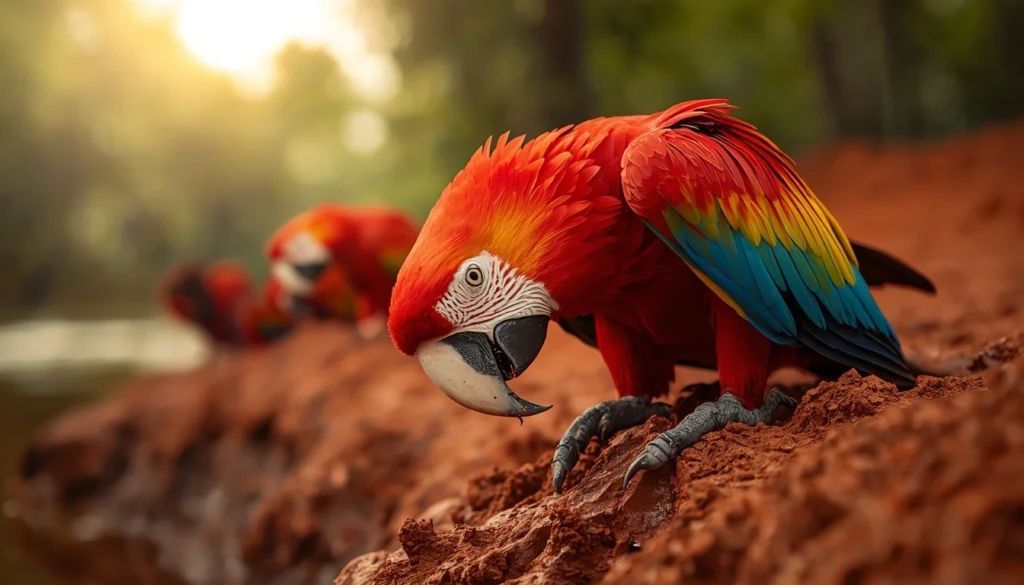
The Power of Geophagy: Why Macaws Visit “Clay Licks”
Wild macaws eat clay to neutralize toxins naturally present in many of the seeds and unripe fruits they consume.
Walk up to a riverbank clay lick (called a colpa) in the Amazon basin on any given morning and you will find hundreds of macaws clinging to the exposed earth, actively scraping and swallowing it. For a long time, researchers assumed they were after mineral supplementation, particularly sodium. More recent fieldwork, including studies from Peru’s Manu National Park, points to a different explanation. The clay appears to bind to alkaloids and other plant toxins, letting macaws safely digest food that would otherwise be harmful.
This matters because wild macaws eat a lot of unripe fruit. Ripe fruit is seasonal and competitive. Unripe fruit is available almost year-round, but it comes loaded with natural defense compounds. Clay licks are essentially the macaw’s detox mechanism. Without them, the bird’s diet would have to be far more restricted.
For captive birds, this is a useful reminder: macaws are built to handle a range of challenging foods. Their guts are tough. That said, “tough” is not the same as “invincible,” and there are still things that will genuinely harm them (see the safety section below).
The Foraging Range: How Far Macaws Actually Travel to Eat
Wild macaws routinely fly 10 to 15 miles per day in search of food, covering multiple habitat types across the same day.
Most people would not guess that. Fifteen miles sounds like a lot for a bird, but macaws are built for it. They have a long, narrow wing shape designed for sustained, fast flight rather than short bursts. GPS tracking studies on Scarlet and Blue-and-Gold macaws in Costa Rica and Brazil have confirmed these daily ranges, and some individuals cover even more ground during fruiting season.
The practical implication for captive birds is less about nutrition and more about behaviour. A macaw that cannot fly far will redirect that physical and mental energy somewhere, usually into screaming, chewing your furniture, or feather destruction. Diet is only one part of keeping a macaw healthy; adequate physical space and foraging activity matter just as much. More on that in the enrichment section.
Natural Protein Sources: Insects and Snails
Wild macaws are not strictly herbivorous. They eat insects, larvae, and snails, particularly during breeding season when protein demand spikes.
This does not mean you need to feed your macaw live bugs, though some owners do without any issues. It does mean that protein requirements are real, and a pure fruit-and-seed diet does not cover them adequately. Pellets formulated for large parrots account for this. A diet built around pellets, with fresh vegetables added daily, will cover protein needs without requiring you to source insects.
If you are curious, cooked egg (scrambled, no salt or oil) is a simple, accepted protein source for macaws. Most birds will eat it readily, especially during moult when protein demand goes up.
Palm Nut Specialists: The Hyacinth’s Unusual Diet
Hyacinth macaws have evolved specifically around high-fat palm nuts, which form the bulk of their wild diet. This does not apply equally to all macaw species.
The Hyacinth is the outlier here. In the Pantanal and Cerrado regions of Brazil, they feed almost exclusively on the nuts of the acuri and bocaiuva palms. These nuts are so hard that virtually no other animal can open them. Hyacinths have the jaw strength and beak geometry to crack them, and they have evolved a digestive system that handles very high fat intake without the same risks smaller species face.
If you keep a Hyacinth, higher fat content in the diet is appropriate and necessary. If you keep a Hahn’s Macaw, a Military, or a Blue-and-Gold, that same fat level will cause problems over time. Species matters when building a feeding plan.
The Ideal Captive Macaw Feeding Plan: The 80/20 Rule
The Pellet Foundation
High-quality pellets should make up 60 to 80 percent of a macaw’s daily diet. They cover nutritional gaps that fresh food alone cannot reliably close.
This is the part most new macaw owners resist, because pellets are boring and seeds look more natural. But seeds, particularly the sunflower seeds most birds prefer, are essentially high-fat snacks. They do not provide balanced nutrition. Pellets do.
The caveat is quality. Cold-pressed pellets made without artificial dyes or preservatives are the better choice. Brightly coloured pellets are visually appealing, but the dyes serve no nutritional purpose, and some birds are sensitive to them. Avian vets commonly recommend brands like Harrison’s, Zupreem Natural, or Roudybush. Buy what your bird will actually eat, and rotate brands slowly if you need to switch.
For a large macaw like a Blue-and-Gold or Green-winged, aim for roughly 60 percent of daily intake from pellets. The remaining 40 percent comes from fresh food.
The “Chop” Methodology: Building a Daily Salad
A daily mix of finely chopped vegetables and cooked grains, prepared in advance and stored in the fridge, is one of the most practical ways to get fresh food into your bird consistently.
The “chop” concept was popularised in parrot-keeping communities as a way to make varied fresh feeding sustainable. The idea is simple: spend one or two hours on a weekend chopping, cooking, and mixing a batch of bird-safe vegetables and grains, then portion it into daily servings and freeze what you will not use within a few days.
A solid base chop for macaws includes dark leafy greens (kale, dandelion leaf, Swiss chard), colourful peppers (red, orange, and yellow have more nutritional value than green), cooked sweet potato, and cooked quinoa or brown rice. Add variety with whatever is in season: zucchini, snap peas, carrots, corn on the cob, broccoli.
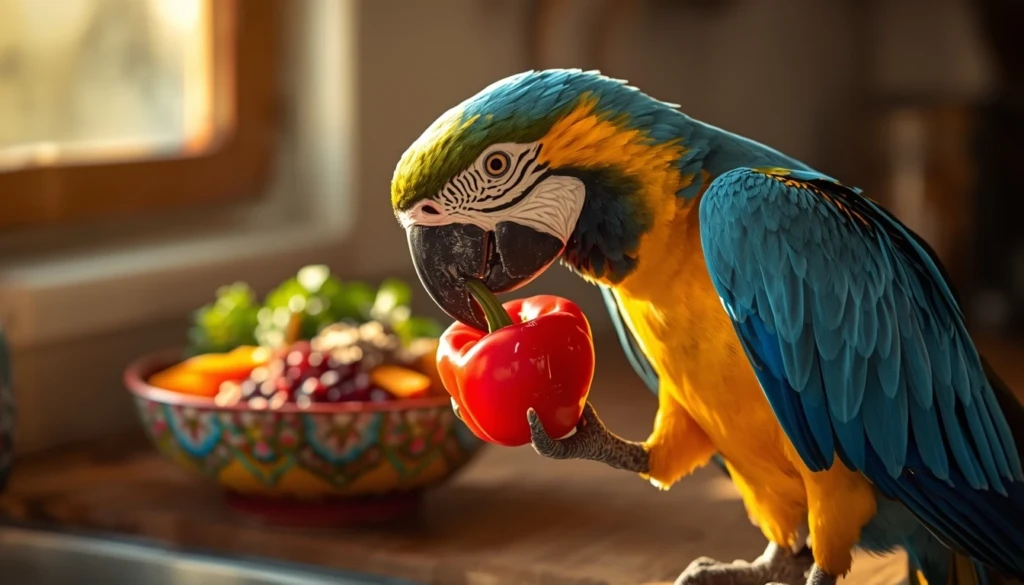
Peppers are worth emphasising. Most macaws love them, they are high in vitamin A, and birds lack capsaicin receptors, so the heat does not register. A red bell pepper is one of the easiest daily vegetables to offer.
Fruit as a Functional Treat
Fruit should be limited to roughly 10 to 15 percent of the diet. It provides antioxidants and variety, but its sugar content makes it a poor dietary staple.
Macaws love fruit, which is exactly why it needs to be rationed. Wild macaws eat fruit opportunistically, when it is available, and burn it off through hours of flying. A captive macaw in an indoor cage does not have the same energy output. Too much fruit over time contributes to obesity, elevated blood glucose, and the kind of fatty deposits that shorten lifespan.
The best fruits to offer are lower-sugar options: papaya, mango (in small amounts), pomegranate, kiwi, and berries. Banana is fine occasionally but is higher in sugar than people realise. Grapes are fine without seeds. Citrus is safe in small amounts but the acidity makes some birds turn their beaks up at it.
Offer fruit as a second meal in the afternoon rather than mixing it into the chop. Birds are smart enough to pick out the sweet pieces if given the option, and they will.
Sprouting for Vitality
Soaking and sprouting seeds or legumes converts them into live, low-fat, enzyme-rich food that macaws find highly attractive and digestible.
Unsprouted seeds are high in fat and relatively inert nutritionally. Soak the same seeds for 12 to 24 hours, rinse them, and let them sprout for another day, and you get something quite different. The fat content drops, the protein becomes more bioavailable, and the live enzymes make them easier to digest.
Sprouting is a bit of work, but not difficult once you build the habit. Good candidates include mung beans, lentils, chickpeas, sunflower seeds (before they become the full-fat version your bird is addicted to), and a range of seeds sold specifically as “parrot sprouting mix.” Rinse the sprouts thoroughly before serving and discard anything that smells off. Sprouts left at room temperature for more than a few hours after washing can grow bacteria quickly, so serve fresh and refrigerate promptly.
Overcoming “Seed Addiction” and Picky Eating
The “Modelling” Technique
Macaws are social birds that learn what is safe to eat partly by watching others eat it. Eating the same food in front of your bird can genuinely trigger interest.
This sounds almost too simple, and honestly, it kind of is, but it works. Macaws in the wild take social cues from flock members about what is worth eating. Your bird watches you. If you sit down with a piece of mango or some steamed sweet potato and eat it with obvious enjoyment, your bird will often investigate within minutes.
The key is authenticity of presentation. Put the food on your own plate. Eat it at the same table as the bird. Make “mmm” noises if you are willing to feel slightly ridiculous. Some birds respond within days. Others take weeks. Either way, this approach does not create stress, which is more than can be said for most coercive feeding strategies.
Transitioning from Sunflower Seeds
Moving a seed-addicted macaw to a better diet requires a gradual reduction over weeks, not an overnight switch. Cold turkey rarely works and can cause real nutritional and psychological stress.
The first thing to accept is that this will take time. A bird that has eaten sunflower seeds its whole life has formed strong preferences, and those preferences are partly about taste and partly about the comfort and control food provides.
Start by mixing a small amount of pellets into the seed mix, roughly 10 percent. Over several weeks, increase the pellet proportion while reducing seeds. Simultaneously, introduce fresh foods at the morning meal (more on timing below). The goal is not to get seeds to zero; a small daily portion of mixed seeds as a treat is fine for most birds. The goal is to stop seeds being the entire diet.
Do not skip meals to force hunger-driven acceptance. Macaws under nutritional stress can develop long-term behavioural problems. Slow, consistent pressure works better than dramatic interventions.
Texture Variety
Macaws often reject new foods based on texture before taste. Offering the same food in different forms (raw, steamed, mashed, whole) can change a refusal into acceptance.
A macaw that ignores raw carrots might demolish steamed carrot mash. A bird that refuses kale leaf might eat it if it is finely shredded into the chop. Some birds only engage with food they can hold in their foot; others prefer food presented in a bowl. Some will tear apart a whole bell pepper but ignore pepper pieces.
There is no universal rule here. You have to know your bird. Keep a rough mental note of what formats generate interest, and use that knowledge when introducing new items.
The “Morning Hunger” Window
Macaws are most food-motivated first thing in the morning. Offering new or less preferred foods at this meal gives them the best chance of being tried.
Birds burn energy overnight and wake up ready to eat. This is the one moment of the day when the calculus of “familiar but unsatisfying” versus “new and uncertain” tips slightly in your favour. If you are trying to get broccoli or pellets or sprouted lentils into your macaw’s diet, morning is the time.
Offer the new or healthy food first. Wait 30 to 45 minutes before offering the more familiar food. Do this consistently. Over time, the new food becomes familiar too.
Safe vs. Toxic Foods: A Critical Safety Checklist
The “Never” List
Several common human foods are toxic to macaws and can cause serious illness or death. Avocado, chocolate, caffeine, alcohol, and rhubarb are the most important ones to know.
Avocado is the most commonly cited risk. The compound persin, found throughout the fruit, in the pit and skin, causes respiratory distress, weakness, and heart failure in birds. There is no safe amount. Even a small bite of avocado flesh can be dangerous.
Chocolate and caffeine affect birds similarly to the way xylitol affects dogs: what is a mild stimulant for a human is a serious cardiac threat for a small animal. The same logic applies to alcohol, even in trace amounts from fermented fruit.
Rhubarb contains oxalic acid at high enough concentrations to cause kidney damage. It is rarely fed to birds intentionally, but it is worth knowing.
Onions and garlic are often listed as bird-safe in small cooked quantities, but the evidence is mixed enough that avoiding them as dietary staples is sensible. They belong in the “occasionally and sparingly” category at most.
The Hidden Danger in Fruit: Seeds and Pits
The flesh of apples, cherries, peaches, plums, and apricots is safe for macaws. The seeds and pits are not. They contain amygdalin, which converts to cyanide in the body.
This one catches people off guard because the fruit itself is perfectly fine. An apple is a good snack for a macaw. An apple with its seeds intact is a different matter. The seeds are small enough to swallow accidentally, and they contain enough amygdalin to cause harm.
The fix is simple: core apples, remove pits and stones from any stone fruit before offering it. Make it a habit you do without thinking.
Nutritional Red Flags: Mould and Overripe Food
Any fruit or vegetable that has begun to mould or smell overripe should be discarded. Mould species that grow on food can produce mycotoxins harmful to birds.
Macaws have a shorter gastrointestinal tract than mammals and less capacity to tolerate spoiled food. The rule for fresh food in the cage is simple: if it has been sitting out for more than two to three hours at room temperature, pull it. In warm climates, less. In summer, less again.
This also applies to the chop you prepare in advance. Frozen chop is fine and safe for weeks. Refrigerated chop should be used within three days. When in doubt, throw it out.
Safe Nut Rationing
Walnuts, Brazil nuts, macadamias, and almonds are safe for macaws but high in fat. Offer them as rewards or training treats rather than dietary staples.
Nuts are useful. They are high-value, most macaws go enthusiastically for them, and they are good training currency. A walnut or a Brazil nut given as a reward for stepping up or tolerating handling is a reasonable daily allowance.
The problem is portion size. A single macadamia nut given to a Hahn’s Macaw every day is a meaningful contribution to fat intake for that bird’s body weight. Scale nut quantity to bird size. A large Green-winged can handle more than a mini macaw without the same metabolic consequence.
Advanced Enrichment: Foraging for Mental Health
Beak Health Maintenance
Macaws need to chew hard materials regularly to maintain beak shape and satisfy a strong biological drive. Hard-shelled nuts and appropriate wood are the best options.
A macaw’s beak grows continuously and is shaped partly by use. In the wild, cracking palm nuts and stripping bark keeps beak shape in check naturally. In captivity, without sufficient hard chewing material, beaks can become overgrown and misshapen, which eventually affects the bird’s ability to eat.
Hard-shelled nuts like walnuts in the shell, or coconut halves with residual flesh, serve the dual purpose of beak maintenance and foraging enrichment. Wood blocks and food-safe branches (apple, willow, eucalyptus) also work. Offer these in addition to food, not as a substitute for it.
Puzzle Feeding
Hiding food inside toys, cardboard boxes, or puzzle feeders extends mealtime and provides the mental challenge macaws need.
This is where the diet and enrichment overlap most directly. A macaw that gets its pellets from a bowl in five minutes is missing several hours of daily mental engagement that a wild bird would spend foraging. Puzzle feeders and foraging toys stretch that out.
Start simple. Wrap a piece of food in paper or place it inside a cardboard box. Move to dedicated foraging toys once your bird understands the concept. Rotate toys regularly so novelty is maintained. The goal is to make the bird work for at least part of every meal.
Messy Enrichment: Pomegranates and Similar Foods
Foods that require active engagement (pomegranates, whole corn, clustered grapes) provide sensory and mental stimulation beyond their nutritional value.
A pomegranate half given to a macaw will keep it occupied for a long time. The bird has to work to access the seeds, the juice goes everywhere, and the whole experience seems to generate genuine satisfaction. Yes, the cleanup is real. That is the trade-off.
Other foods in this category include whole ears of corn (still in the husk, letting the bird strip it), whole cluster grapes still on the stem, broccoli florets that have to be disassembled, and intact bell peppers. These are not just food. They are activities.
Species-Specific Requirements
Fat and calorie requirements vary meaningfully between macaw species. A Hyacinth needs a diet significantly richer in fat than a Hahn’s. Treat feeding guidelines as species-specific, not universal.
If you have multiple macaw species, build each bird’s diet separately rather than feeding everyone the same thing. A Hyacinth maintained on a low-fat diet will gradually show signs of deficiency. A Hahn’s on a high-fat Hyacinth diet will eventually develop weight problems.
If you sourced your bird from a reputable breeder, ask what diet the parents were maintained on. Breeders like NG Parrots, who raise hand-bred macaws from carefully managed bloodlines, typically provide detailed dietary notes with their birds and can advise on the specific needs of the species they work with.
Frequently Asked Questions
Can macaws eat blueberries and other small berries?
Yes. Blueberries, raspberries, strawberries, and similar berries are safe and genuinely nutritious for macaws. They are high in antioxidants, low in sugar relative to sweeter fruits, and most birds eat them with enthusiasm. Offer them as part of the fruit allocation (the 10 to 15 percent of daily diet) rather than as a daily staple. Wash thoroughly before offering, and avoid any berries that have begun to go soft or mouldy.
How much fruit should a macaw eat daily?
A good rule of thumb is one to two tablespoons of fruit per day for a small macaw, and up to a quarter cup for a large species like a Blue-and-Gold or Scarlet. This is a rough guide rather than a precise prescription. The more important principle is that fruit should not crowd out pellets and vegetables. If your bird is eating fruit well but refusing vegetables, reduce the fruit temporarily. Birds prioritise sweet food when it is available.
Is a seed-only diet bad for macaws?
Yes, and this is not a debated point in avian nutrition. Seed-only diets are deficient in protein, calcium, vitamin A, and several other nutrients that macaws need to stay healthy. Birds on long-term seed diets frequently develop fatty liver disease, vitamin A deficiency (which causes respiratory and feather problems), and compromised immune function. Sunflower seeds in particular, because they are what most birds prefer, are roughly 50 percent fat and lack most of the nutrients a balanced diet requires. Seeds have a place in the diet as a treat or training reward. They should not be the whole meal.
What are the best vegetables for a macaw’s feather health?
Feather quality correlates most directly with protein intake and vitamin A status. For vitamin A, dark orange and red vegetables are the best sources: red bell peppers, sweet potato, and carrots. Dark leafy greens like kale and dandelion leaf are also high in vitamin A precursors. For protein, cooked legumes (lentils, chickpeas), sprouted seeds, and cooked egg supplement what pellets provide. If a bird has persistent feather problems, including poor feather texture, colour changes, or stress bars on the feathers, get a veterinary workup before assuming diet is the sole cause. Feathering problems can have hormonal or infectious causes as well.
Why do macaws eat clay in the wild?
The leading explanation is detoxification. Many of the seeds and unripe fruits that macaws eat contain alkaloids and other compounds the plant produces as a defence against being eaten. Clay particles, particularly those with high cation exchange capacity, bind to these compounds in the gut and allow safe digestion. Some researchers also point to sodium supplementation as a secondary benefit, since clay deposits in many macaw habitats are relatively sodium-rich. The behaviour is not unique to macaws but is particularly well-documented in them, especially in South America where large clay licks attract dozens of species simultaneously.
Can macaws eat apple seeds?
No. Apple seeds contain amygdalin, which the body converts to hydrogen cyanide. The risk from a single seed is low for a large macaw, but there is no benefit to including them, and the habit of offering apples with seeds is not worth developing. Remove the core and seeds before offering apple slices. The same applies to any stone fruit: remove the pit from cherries, peaches, nectarines, plums, and apricots before feeding the flesh.
Do I need to peel fruit before feeding my macaw?
For most fruits, no. Macaw beaks are well-equipped to strip skin, and some birds prefer working on whole fruit rather than pre-peeled pieces. However, non-organic fruit should be washed thoroughly, as pesticide residue on the skin is a genuine concern. If you are not buying organic, consider peeling fruits that are known to carry higher pesticide loads (apples, grapes, peaches, strawberries are commonly cited). For fruits with very thick skins like pineapple or citrus, cut them open rather than offering whole so the bird can access the flesh without difficulty.